Suno Vs Udio 2026
Suno Vs Udio 2026
In the high-stakes world of May 2026 AI music generation, two names absolutely dominate the landscape: the pioneering titan, Suno, and the hyper-advanced producer’s favorite, Udio. While both turn text into tracks, they are now targeting fundamentally different creators.
I put both platforms through a hands-on free tier experience to see which one actually holds up under pressure—and observed some pricing limitations and restrictions along the way. Here is what you need to know before handing over your subscription cash.
Quick Verdict: Which One Should You Choose?
- Choose Suno if: You want a highly usable free tier that generally respects your prompt instructions (like tight BPM constraints), lets you download your files, and gives you a clear audio preview of what the premium paid engine can offer.
- Choose Udio if: You don’t mind paying right out of the gate. Its free tier is more limited, blocks track downloads, and may not consistently follow specific speed tags, with credit increases tied to a 7-day free trial structure.
1. Suno: The Catchy, High-Fidelity Tease
Suno remains the strong example of “prompt-to-hit.” Its flagship v5 model produces incredibly natural vocal performances and has successfully transitioned from a generator into a large, user-friendly creative ecosystem. It’s built for speed, and the workflow is a total breeze—even if there are built-in upsell prompts designed to encourage upgrading.
Key 2026 Features & Testing Reality:
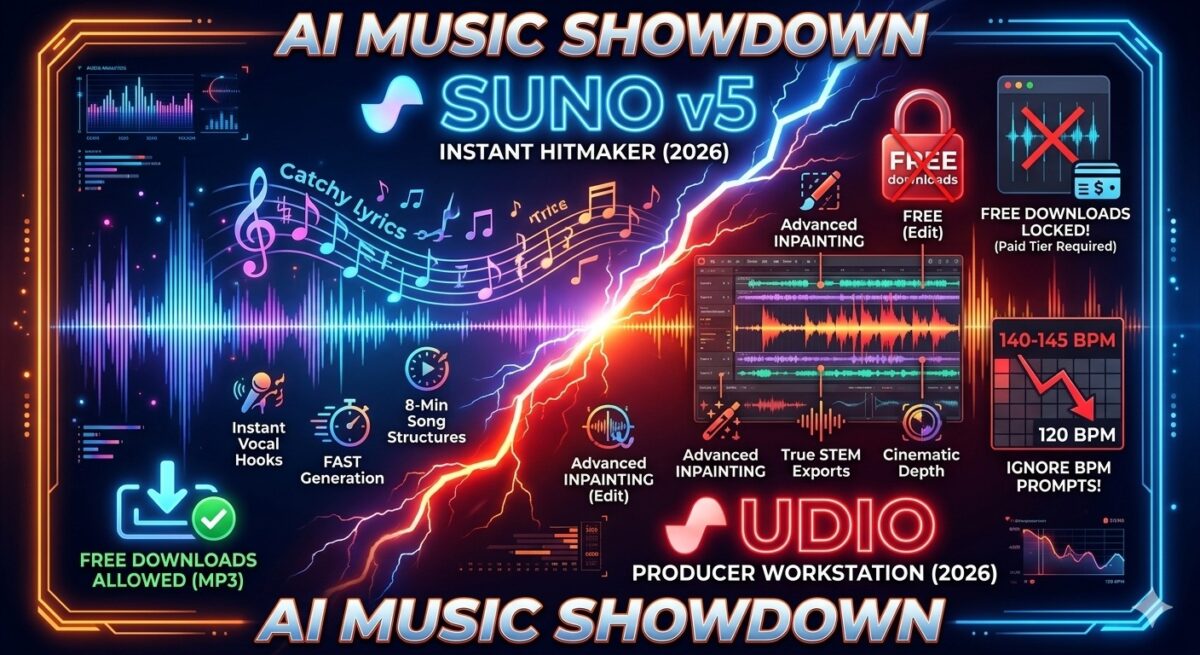
- The High-Quality Preview: Suno’s free tier sounds decent, but it offers an upgraded paid-tier preview of the same track you just created. The paid version is noticeably sharper, cleaner, and more radio-ready—but that version is only available for download with a subscription.
- Generous Free Downloads: Even though higher-quality audio is previewed behind a paywall, Suno still allows free-tier users to download standard MP3 versions of their creations directly.
- 8-Minute Generations (v4.5/v5): No more stitching together fragmented sections. Suno can produce cohesive song structures up to around 8 minutes in a single generation.
2. Udio: The Feature-Locked Workstation
Udio—built by former Spotify AI engineers—is positioned as a high-end AI music workstation for more advanced users. However, using the platform on a free tier reveals significant usage limits, structured paywalls, and occasional output inconsistencies that can affect creative control.
Key 2026 Features & Testing Reality:
- The 120 BPM Limitation: Udio’s free engine may not consistently follow strict tempo instructions. In some cases, faster BPM prompts can result in a more mid-tempo output than expected.
- The Free Tier Download Restriction: While Udio provides free credits to experiment inside its browser app, free users cannot download their tracks. Output remains within the platform unless a paid plan is activated.
- The Free Trial Catch: Udio advertises a “7-Day Free Trial” for its Standard plan, but access to increased credits may still follow the full billing activation cycle, meaning basic limits can remain in place during the trial window.
Head-to-Head 2026 Comparison
| Feature | Suno (v5) | Udio |
|---|---|---|
| Primary Workflow | Text Prompt -> Full 8-Min Song | Incremental Building & Surgical Editing |
| Free Tier Downloads | Yes (Can download base MP3s for free) | No (Track downloads are totally paywalled) |
| Prompt/BPM Accuracy | High (Nailed fast 140–145 BPM requests) | Low on Free (Fumbled 145 BPM down to 120 BPM) |
| Free Trial Trap | No hidden trial catches | Yes (7-day trial blocks credit limit increases) |
| Audio Quality Tiers | Lets you preview premium sound samples | Hidden behind flat paid tiers |
| Surgical Editing | Basic Song Cropping & Extensions | Advanced Inpainting & Audio Remastering |
2026 Pricing Structure (Billed Annually)
Both platforms offer free credits, but the overall prompt accuracy, download capabilities, and credit limits change drastically when you invest in their annual tiers.
| Tier | Suno Pricing (Annual) | Udio Pricing (Annual) |
|---|---|---|
| Free | $0/mo: 50 daily credits (10 songs). Free downloads allowed, but premium audio quality is locked behind a “preview-only” tease. | $0/mo: 10 daily credits. Downloads completely blocked. Prompt features are highly limited and prone to pacing errors. |
| Standard / Pro | $8/mo ($96 billed annually): Unlocks the high-fidelity engine you previewed on the free tier, commercial rights, and saved Personas. | $8/mo ($96 billed annually): Unlocks track downloads, editing tools, and true credit limit increases (after the 7-day trial ends). |
| Pro / Premier | $24/mo ($288 billed annually): Unlocks 10,000 monthly credits. Maximum priority queue, and full Suno Studio DAW access. | $24/mo ($288 billed annually): The ultimate package for super-creators. Highest generation limits and pro-level production features. |
Export to Sheets
Hands-On Testing: The Honest Breakdown
I hit both platforms with a fast-paced, high-energy prompt, demanding a driving electronic beat locked strictly between 140 and 145 BPM.
I used both platforms with a fast-paced, high-energy prompt, aiming for a driving electronic beat locked strictly between 140 and 145 BPM.
My Take on Suno: Suno handled the speed request well, generating a track that stayed close to the requested 140–145 BPM range. When previewing the paid subscription engine, the difference was noticeable—the bass hit harder, the mix was cleaner, and the overall production felt more polished. This appears to be part of an upsell system, but the free tier still delivers a usable export.
My Take on Udio: In this use case, Udio struggled to match the requested tempo range, producing a noticeably slower result than expected. Combined with the fact that downloads are blocked and certain features remain behind paid access, the free experience can feel more like a limited demo environment than a fully complete production tool.
Final Thoughts: Demographics Matter
In 2026, the free tiers draw a clear line in the sand:
Suno is built for immediate creation. Even though it may introduce premium previews, it generally follows prompts well, delivers usable exports, and provides a fast, creative workflow from day one.
Udio requires more commitment to properly evaluate. The free tier is useful for exploration, but it doesn’t always reflect the platform’s full capability, especially in terms of control, downloads, and production depth.
This comparison covers the key differences between Suno and Udio, but if you’d like a closer look at Suno’s features, pricing, strengths, and limitations, read our complete Suno Review.